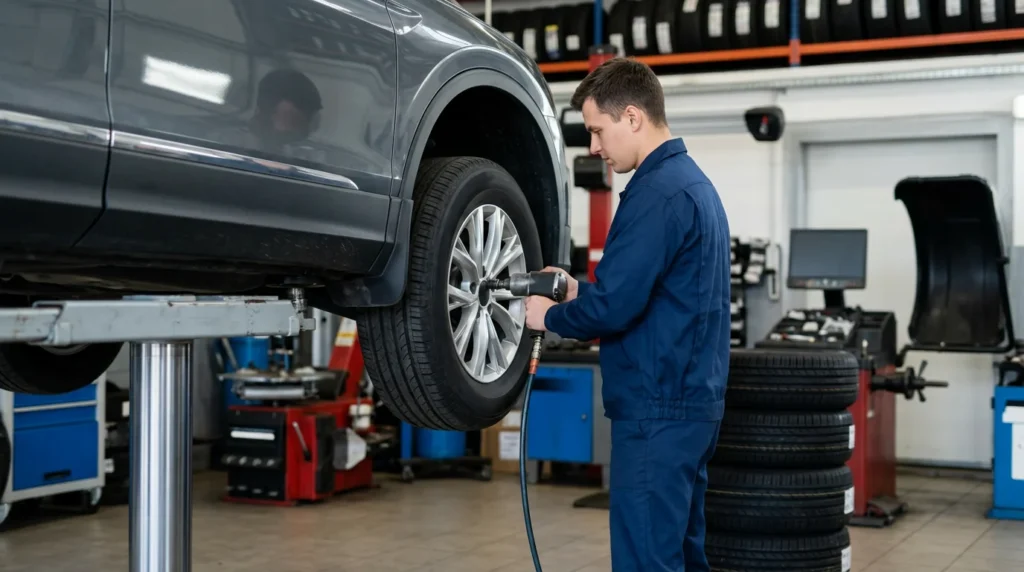
Quick answer: Choose a reliable tire shop in Buford by asking about their repair policy (tread-only punctures, no sidewall repairs), whether they inspect tread/sidewalls inside and out, how they balance (modern equipment and a recheck if vibration remains), whether they verify TPMS operation after service, and whether they can perform alignment or refer you for it. A good shop explains wear patterns and shows you what they found.
What “Tire Service” Usually Includes
Reliable tire service starts with a consistent process, not just swapping rubber. Use a quick checklist when calling around Buford: Do they inspect tread depth across the tire (including the inside shoulder), check sidewalls for bubbles/cuts, set pressures to the door-jamb spec, and verify TPMS readings after the work is done? Do they explain why a tire is repairable or not, and will they show you the nail/screw or the wear pattern?
If you’re comparing options for tire services buford, ask if they’ll check the inside shoulder too—many alignment or suspension issues show up there first. In the Buford area, pothole hits and rough patches can also bend a wheel or knock off a wheel weight, so a thorough shop won’t assume a “simple balance” without at least considering wheel condition.
Common services include flat repair (only when the puncture is in the tread area and the casing isn’t damaged), rotation, balancing, and new tire installation. Good tire work also includes re-torquing lug nuts to spec and confirming you don’t leave with a new vibration or a still-on warning light.
A Simple Decision Tree for Booking the Right Service
1) Slow leak or TPMS light: Book a leak check/flat repair first. A reliable shop should verify pressure with a gauge, inspect the tread and sidewalls, and then locate the leak (often by soapy water or a dunk tank). They should check the valve stem/core and bead area, not just the tread. If the TPMS light is on, they should confirm whether it’s low pressure versus a sensor issue, and verify the system reports correctly after inflation/repair.
2) Vibration at speed (often most noticeable around typical commuting speeds): Book a balance and vibration diagnosis. A reliable shop should balance all four wheels, clean mounting surfaces, and recheck if the vibration persists. They should also look for bent wheels, tire bulges, separated belts, or missing weights—especially if the vibration started after a pothole impact.
3) Uneven wear or pulling: Book an alignment check and tire inspection. A reliable shop should measure alignment angles, inspect steering/suspension parts for play, and explain the wear pattern (inside edge, outside edge, feathering, cupping). If tires are already worn unevenly, they should tell you whether rotation is still helpful or if replacement is the safer move after the underlying issue is corrected.
How to Tell If a Tire Can Be Repaired
A safe repair depends on location and damage type. Punctures in the main tread area are often repairable if the hole is small and the tire hasn’t been driven flat. Sidewall punctures and cuts generally aren’t repairable because the sidewall flexes too much and damage there can weaken the structure.
Also watch for “run-flat” damage on regular tires. If you drove on low pressure, the sidewalls can overheat and separate internally even if the outside looks fine. Clues include a shredded inner liner, rubber dust inside the tire, or a wavy sidewall. In those cases, replacement is usually the safer call.
Ask what repair method is used. A proper plug-and-patch style repair from the inside is typically preferred over an exterior plug alone because it seals the inner liner and helps stabilize the injury channel.
Questions to Ask So You Can Compare Shops Confidently
Use a neutral comparison rubric so you’re not guessing. Ask: “What makes a tire non-repairable?” Good answers mention sidewall damage, shoulder-area punctures, and evidence of driving on a flat. Ask: “Do you remove the tire to inspect and repair from the inside?” Good answers describe an internal patch/plug repair, not only an exterior plug.
For vibration concerns, ask: “How do you balance, and what do you check if it still shakes?” Good answers include balancing all four, checking wheel condition (bends), checking for tire bulges/separation, and confirming proper mounting. For warning lights, ask: “Will you verify TPMS after service?” Good answers include confirming sensor readings and resetting/relearning if needed.
For wear issues, ask: “Can you check alignment or refer me if that’s the cause?” Good answers include measuring alignment angles and inspecting suspension/steering parts, not just selling tires. If you want one place to start, Team Ryan Automotive is one local option to contact for tire inspections and related repair guidance.