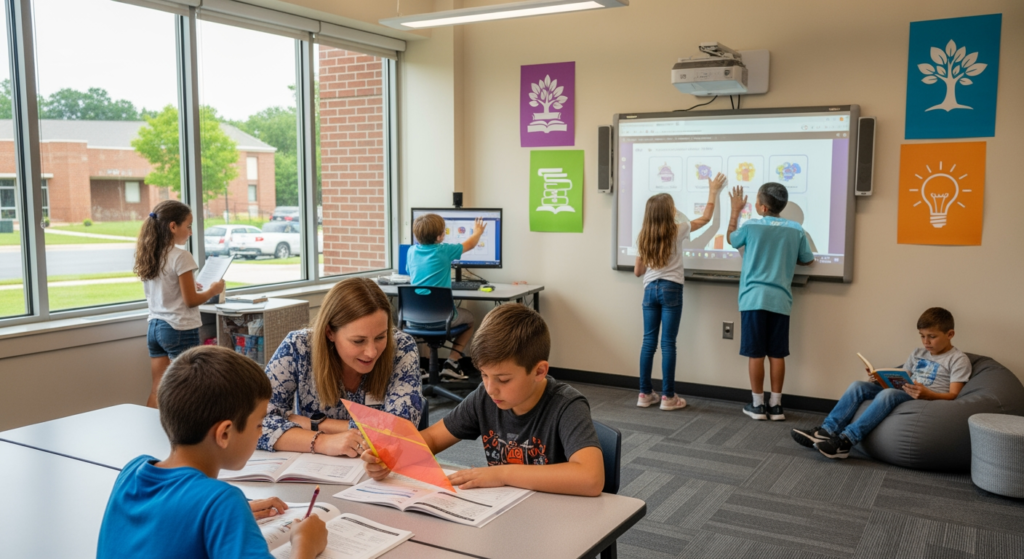
If your child struggles with reading, getting the right help can feel overwhelming at first, but the right placement makes a big difference. For families exploring options, a focused dyslexia support school Lawrenceville GA can deliver tailored instruction and steady progress. You can also find helpful statewide guidance through the Georgia Department of Education homepage to learn about local screening and intervention expectations https://www.gadoe.org.
Why early, specialized support matters
I’ve seen families wait through months of frustration before they find the right support, and that delay costs confidence. Dyslexia is not a sign of low intelligence. It’s a difference in how the brain processes written language, and when we address it with structured, evidence-based instruction, students often catch up—and sometimes surpass—their peers. Early intervention lowers anxiety around school, prevents the gaps that make later learning harder, and preserves a child’s love of learning.
What true dyslexia support looks like
Not every reading program is built the same. A strong program in the Lawrenceville area delivers these features consistently:
- Explicit, structured literacy that teaches phonology, orthography, morphology, syntax, and semantics in a clear sequence.
- Multisensory methods that combine touch, sight, sound, and movement so students form stronger memory traces for words and rules.
- Small-group instruction or one-on-one tutoring with practitioners trained in structured literacy approaches.
- Regular, objective progress monitoring so instruction changes based on results, not on hope.
Structured literacy as the foundation
Structured literacy is at the heart of effective dyslexia support. It’s systematic and cumulative: lessons build on each other, teachers explicitly model rules and patterns, and students practice with immediate feedback. I recommend looking for language that mentions phonemic awareness, decoding, encoding (spelling), and morphology. Those terms indicate a rigorous, research-backed approach rather than a catch-all “reading program.”
Multisensory and student-centered instruction
Multisensory teaching supports more than one learning pathway. It’s not just gimmicks—using manipulatives, writing letters in sand, and saying sounds aloud strengthens the connections a child needs to read fluently. In a classroom that uses multisensory strategies, learners with dyslexia feel the lesson as well as hear and see it, which improves retention and fluency over time.
Assistive technology and accommodations
Assistive technology is a growing trend in dyslexia support, and it’s particularly useful for older students catching up during middle and high school. Tools like text-to-speech, speech-to-text, smart dictionary apps, and adaptive reading platforms help students access grade-level content while they continue to build decoding skills. Ideally, assistive tech is paired with systematic instruction—not used as a stand-alone fix.
How to evaluate programs in Lawrenceville GA
When touring schools or programs near downtown Lawrenceville or the surrounding neighborhoods, keep a checklist handy. I recommend asking for demonstrations, not just brochures. Seeing a short lesson or a progress report example tells you far more than glossy testimonials.
- Ask to see curriculum samples and the specific structured literacy approach the program uses.
- Request recent progress monitoring data so you can judge how quickly students improve.
- Check staff credentials and training—look for certification or professional development in structured literacy and dyslexia-specific methods.
- Observe classroom size for reading instruction and the ratio of specialists to students during interventions.
Questions to ask during a visit
Bring a few targeted questions to your visit to get clear answers. Ask how teachers adapt lessons when a student plateaus, what formal screening tools they use, and how families receive updates. I always suggest asking for a sample week of lessons so you can see the pacing and balance between review and new content.
Common concerns parents raise
Parents often worry about labels, timelines, and whether special instruction will stigmatize their child. From experience, clear communication and a strengths-based approach reduce anxiety. Here are common questions and practical answers:
Will my child be labeled forever?
Labels can feel permanent, but they are actually tools. When we identify dyslexia, it opens access to the right instruction and accommodations. Many students who receive proper support go on to read independently and need fewer accommodations as they progress. The goal is functional independence, not permanent dependence.
How soon will I see improvement?
Progress depends on intensity and the match between instruction and student needs. With daily targeted instruction, families often see measurable gains within 8–16 weeks on specific decoding or fluency measures. That said, reading comprehension may take longer, especially if the student missed foundational skills for several years. Regular progress monitoring gives clear timelines and helps teams adjust instruction quickly.
Is it only about decoding words?
Decoding is essential, but full reading instruction includes vocabulary, comprehension strategies, writing, and study skills. A strong program strengthens each of these areas so students can apply decoding skills to real classroom work and tests. We always want instruction to be purposeful and connected to classroom expectations.
Local trends and what’s changing in education
Two trends are shaping dyslexia support locally and nationally right now. First, more schools are adopting screen-and-respond models to catch literacy struggles earlier. Second, there’s growing emphasis on teacher training in structured literacy so classroom instruction is more consistent across grades. These shifts are helping communities like Lawrenceville see earlier identification and more targeted intervention.
At the same time, assistive tech adoption is rising. Schools and families are pairing human-led instruction with technology that reduces barriers to content. For older students, this blend keeps them engaged in grade-level work while remediation continues.
Practical daily steps parents can take at home
Home routines matter. Even small, consistent habits make a big difference in reading confidence and skill. Here are actions you can start tonight that support formal instruction without adding stress.
- Set a short, predictable reading time each day where you read together or listen to an audiobook while following the text.
- Play phoneme games (clapping syllables, identifying first and last sounds) to keep phonological skills active.
- Celebrate effort and strategy use rather than speed—praise the method as much as the result to build persistence.
How teams coordinate support
Effective support is collaborative. Teachers, reading specialists, parents, and often a school psychologist form a team that shares goals and data. Good programs set a clear communication cadence—weekly or biweekly updates during intensive intervention phases and monthly summaries afterward. If your child has a 504 or IEP, the same data-driven approach should guide goals and accommodations.
What progress monitoring looks like
Progress monitoring uses short, standardized measures to see if instruction is working. Scores on these probes tell the team whether to intensify, change, or maintain the plan. When I review interventions, I look for consistent upward trends over several data points as a reliable sign of effectiveness.
What success feels and looks like
Success is more than test scores. It’s the moment a student reads a paragraph without dread, volunteers to read aloud, or completes homework with confidence. Academically, success shows up as steady gains in decoding accuracy, increased reading rate, and improved comprehension. Socially and emotionally, success shows up as reduced anxiety, greater participation in class, and a willingness to tackle challenging texts.
Making the choice in Lawrenceville
You know your child best. When you combine that knowledge with concrete program evidence—curriculum samples, progress data, and trained staff—you can make a decision that fits your family. Look for a program that treats reading as a skill to be taught explicitly, tracks progress carefully, uses multisensory methods, and partners with families. Visiting classrooms in the downtown Lawrenceville area or nearby neighborhoods can give you a sense of fit and culture that materials alone cannot convey.
Final checklist before enrolling
Before you enroll in any program, run through this final quick checklist to make sure expectations are aligned and support will be sustained.
- Does the program provide a clear initial assessment and ongoing progress reports?
- Are the teachers trained in structured literacy and dyslexia-specific strategies?
- Will the program coordinate with your child’s regular school and provide accommodations where needed?
Conclusion and next steps
If you’re ready to take the next step and want a focused program in Lawrenceville that follows structured literacy practices and multisensory instruction, I encourage you to reach out and schedule a visit. Seeing lessons in action and reviewing progress examples will give you the clearest picture of how a program can help your child thrive. For a local option that combines specialized curriculum, trained staff, and family partnership, consider contacting Sage School for more information and to arrange a tour.