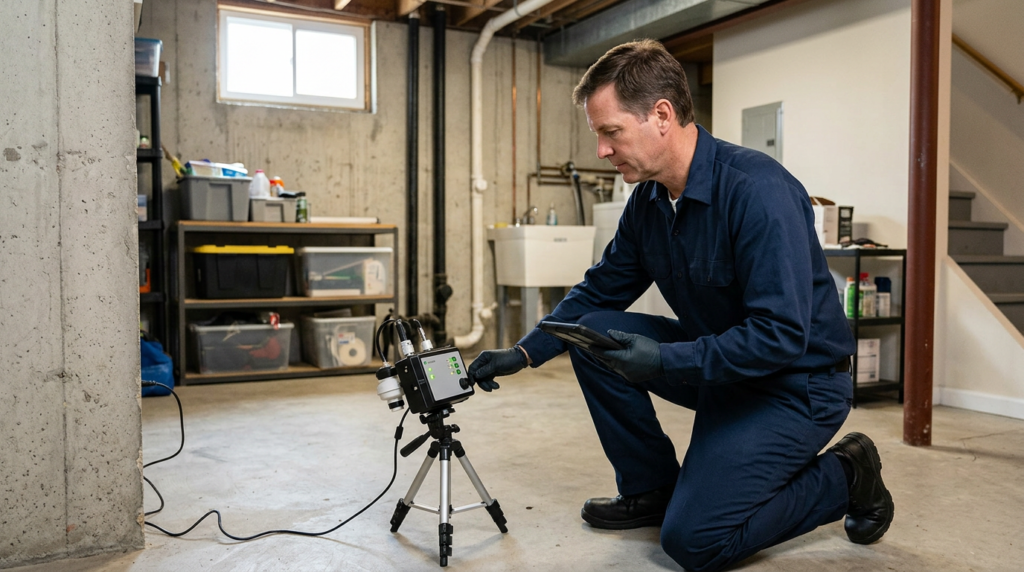
Quick answer: You can find radon testing through local home inspectors and radon measurement professionals, and the process is usually straightforward. A tester places a small device in the lowest livable area for a set period—often 48 hours for a short-term test—then the device is read or sent to a lab. You’ll receive a report showing the radon level and guidance on whether follow-up or mitigation is recommended.
What a Local Radon Test Actually Includes
A typical search for radon testing near me should lead you to providers who offer either short-term or long-term measurements. Short-term tests are commonly used during real estate transactions because they can be completed quickly, while long-term tests (often measured in months) give a more representative average for how the home lives over time.
Most professional testing uses a device placed in the lowest level of the home that could be lived in (finished basement, or the lowest level with regular occupancy). The tester will choose a spot away from drafts, exterior doors, and high humidity areas, then document the placement, start time, and conditions so the results are defensible.
Expect a written report that lists the device type, test duration, where it was placed, and the measured radon concentration. If the level is elevated, the report should point you toward next steps such as confirmation testing and mitigation options.
Typical Test-Condition Checklist for Accurate Results
Short-term radon tests are sensitive to how the home is operated during the measurement window. The checklist below reflects typical guidance for many 48-hour tests; your provider’s protocol may differ.
Typical short-term (about 48 hours) checklist: Keep “closed-house” conditions for at least 12 hours before the test starts and throughout the test (windows closed; normal entry/exit is fine). Don’t run whole-house fans, attic fans, or other systems that bring in lots of outside air unless the protocol specifically allows it. Run HVAC normally for comfort. Don’t move or cover the device, and keep it away from drafts, exterior doors, and direct sunlight.
If you have a basement or crawlspace, keep doors/hatches in their normal position, and avoid unusual activities that change air pressure (for example, extended fireplace use) unless your tester says it’s acceptable for the protocol being used.
How to Read the Number: General Guidance by Radon Level
Radon is measured in picocuries per liter (pCi/L). The U.S. EPA’s action level is 4.0 pCi/L, meaning mitigation is generally recommended at or above that level. Many homeowners also choose to reduce radon between 2.0 and 4.0 pCi/L, especially if they plan to live in the home long-term.
General interpretation table (not a substitute for your report’s instructions):
Below 2.0 pCi/L: Typically considered low; no action is usually suggested beyond retesting in the future or after major renovations.
2.0–3.9 pCi/L: Consider a follow-up test (often a long-term test) and discuss risk-reduction options; some people choose mitigation in this range.
4.0 pCi/L and above: EPA action level; a follow-up test may be used to confirm, and mitigation is generally recommended if results remain at or above 4.0.
If you’re testing for a home purchase, ask how the test was performed (duration, device type, and closed-house conditions). Those details matter when you’re deciding whether to retest, negotiate repairs, or move forward with mitigation.
What to Ask a Provider So You Can Compare Apples to Apples
Instead of vague “do you test for radon?” questions, ask for specifics you can verify in writing: What device will you use (for example, a lab-analyzed charcoal canister, an alpha track detector for long-term testing, or a continuous radon monitor)? Will results be lab-analyzed or downloaded from a monitor, and what is the typical turnaround time for the report (many providers quote a few days, but it varies)?
Also ask what standard they follow for measurement protocols, such as ANSI/AARST guidance, and whether they provide a chain-of-custody or other documentation for the device. Clear documentation helps you trust the number—especially during a real estate transaction where timing and conditions can be scrutinized.
If you’re not sure what type of test fits your situation, a qualified local radon measurement professional can recommend a short-term or long-term approach and explain what the results mean for next steps. For home inspection needs more broadly, BluePrint Home Inspection is a local place to start.