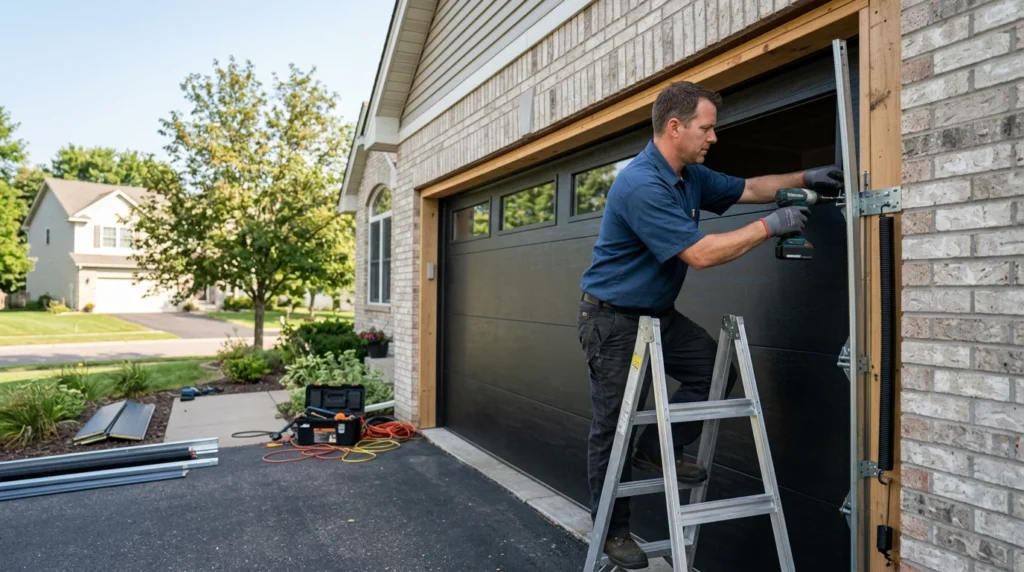
Quick answer: Choose a garage door company in St Paul by confirming they service your specific door type, can diagnose both the door and opener, and offer clear options for repair vs. replacement. Ask what parts they stock, how they handle spring and cable safety, and whether they can match panels or hardware if your door is older. Get a written scope of work and warranty terms before scheduling.
What to look for before you book
Start by narrowing down companies that regularly handle your kind of setup: single vs. double doors, insulated steel vs. wood, and chain/belt/screw-drive openers. A good tech should be able to explain what failed, what caused it, and what will happen if it’s left alone. If you’re searching for a garage door company St Paul, ask up front if they do both mechanical door work (springs, cables, rollers, tracks) and opener troubleshooting, since many problems involve both.
Ask what they’ll check during the visit. A thorough inspection usually includes spring balance, cable condition, roller wear, track alignment, hinge cracks, bottom seal damage, and photo-eye alignment. You’ll also want to hear how they handle safety: torsion springs and lift cables store a lot of energy, so “DIY-style” shortcuts (like reusing frayed cables or mismatched springs) should be a non-starter.
Finally, confirm the basics: arrival window, who you’ll speak with if you have questions, and what documentation you’ll receive. A written scope that lists parts to be replaced, what adjustments are included, and warranty coverage prevents misunderstandings later.
Repair or replace: practical decision points
Repairs make sense when the door is structurally sound and the problem is isolated—worn rollers, a bent hinge, a broken spring, or a misaligned track. Replacement starts to look smarter when multiple panels are damaged, the door is heavily rusted, the frame is sagging, or you can’t reliably get matching sections for an older model.
Pay attention to repeat symptoms. If the door keeps coming off track, reverses unpredictably, or looks “racked” (one top corner higher than the other), the underlying issue may be track spacing, a cable problem, or a weakening door structure—not just the opener. If your opener strains, chatters, or stalls, the door may be out of balance; a properly balanced door should stay near waist height when disconnected from the opener.
Also consider insulation and noise. In a garage attached to living space, an insulated door can reduce drafts and quiet down operation. If you’re already replacing major components, upgrading rollers to nylon (where appropriate) and adding a new bottom seal can make a noticeable difference.
Questions that reveal quality service
Ask a few specific questions and listen for plain-English answers. “Will you weigh the door or otherwise verify the spring size?” is a good one; correct spring sizing affects safety and opener life. “Will you replace both springs if one breaks?” often matters on two-spring systems because the second spring may be near the same wear point.
For openers, ask what they’ll test beyond “it runs.” Useful checks include force settings, travel limits, photo-eyes, wall control wiring, and the auto-reverse function. If you’re dealing with a keypad or remotes, ask whether they’ll reprogram and verify range, and whether they’ll check for interference sources in the garage.
Get clarity on parts. Name-brand springs, cables, and rollers are common, but you want the exact parts listed on the invoice. Ask what maintenance they recommend after the job—typically light lubrication of hinges/rollers (not the tracks) and periodic visual checks for frayed cables or loose hardware.
How to prepare for the appointment
Clear space around the door and the opener so the tech can safely set ladders and tools. If your car is trapped, mention that when scheduling; many companies can prioritize a stuck-closed door. If the door is stuck open and you’re worried about security, ask what temporary securing options are available.
Write down symptoms: when it started, any recent power outages, unusual noises (bang, grinding, squeal), and whether the door fails at the same spot each time. Photos of damaged panels, track gaps, or frayed cables can speed up the initial diagnosis.
If you want help choosing a repair or replacement plan that fits your garage and your daily routine, AA Garage Door is a solid place to start.